
Exterior House Painting in Raleigh, NC
Triangle homes take a beating — strong summer sun, humidity, and long wet stretches. An exterior finish only lasts if the preparation underneath it is right, so that's where most of our time goes. It's the least glamorous part of the job and the part customers mention most in our reviews.

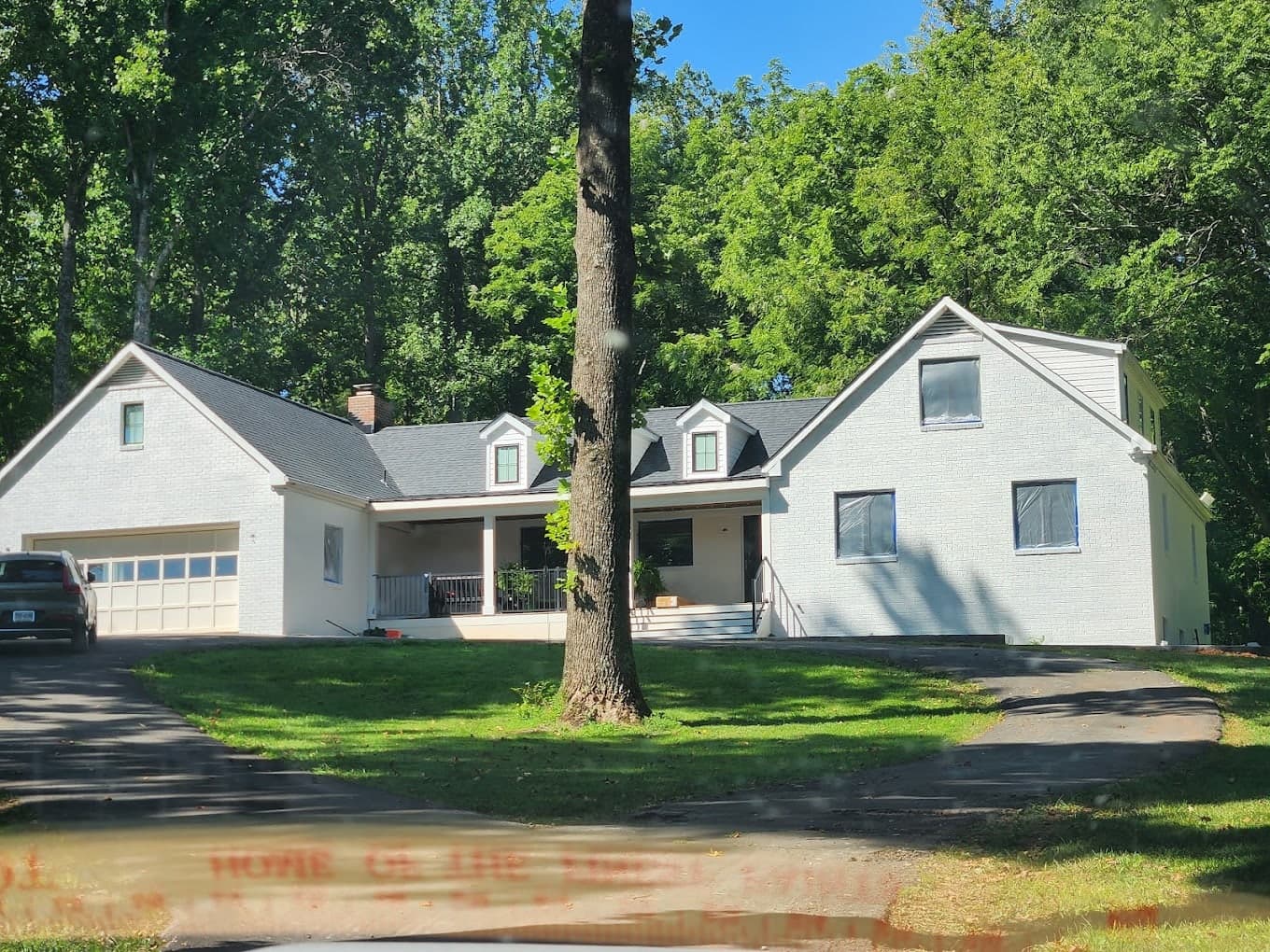
How we work
- 01
Inspect
We walk the full exterior with you and point out what needs extra prep before paint is even discussed.
- 02
Wash
Pressure washing to strip dirt, chalking and mildew so the new coating bonds to a sound surface.
- 03
Scrape and repair
Failing paint scraped back, damaged wood and trim repaired, gaps sealed.
- 04
Prime and paint
Bare and repaired areas primed, then finish coats applied with clean lines at trim and windows.
- 05
Final walkthrough
We walk the property with you before packing up, and we clean up after ourselves.
Why preparation is most of the price
An exterior coating fails at the bond, not in the film. Paint that peels is almost never bad paint; it is good paint stuck to chalk, dirt, mildew or a surface that was still wet. That is why the majority of the hours on any exterior we quote sit before the first finish coat.
The sequence does not vary: wash, let it dry properly, scrape back failing film to a sound edge, repair the wood and trim that the scraping exposes, cut out and replace failed caulk, spot-prime every bare surface, then paint. Each step exists because the one after it does not work without it.
This is the honest explanation for the spread in exterior quotes. Two numbers on the same Triangle house can be thousands apart, and the gap is prep. Ask both bidders what happens between the wash and the paint. The one who can answer specifically — how failed caulk is handled, what gets primed, what happens to rotted trim — is describing a different job from the one who says the house gets two coats.
The Triangle weather that decides your schedule
Three local conditions govern exterior work here, and none of them appear on a paint can.
Pine pollen, roughly late March through mid-April, is the one nobody warns you about. It settles into wet film and it settles onto a surface you washed yesterday, which means a house cleaned on a heavy pollen day is not clean when the primer goes on. We either schedule around the peak or re-rinse immediately before coating. It is the single most common reason a Triangle exterior gets rescheduled in spring.
Summer surface temperature is the second. Air temperature is not the number that matters — a south- or west-facing wall in July can sit 30 to 40°F above it, past what most exterior coatings tolerate. Paint applied to a surface that hot flashes off before it can level and flow, and the result is poor film formation that shows up as early failure. The answer is to follow the shade around the house, which means a summer exterior is sequenced by orientation rather than by whichever side is most convenient.
Humidity and dew point is the third, and it bites in autumn. A wall that reads dry at four in the afternoon can be wet with dew by eight, and a coat that has not properly formed its film by then is compromised overnight. Stopping earlier in the day late in the season is not laziness; it is the difference between a finish that lasts and one that does not.
Wood, fibre cement, vinyl, stucco and brick
Every substrate on a Triangle house fails in its own way and needs a different answer.
Wood — the older stock in Durham, Raleigh's inner neighbourhoods, and the historic cores of Apex, Wake Forest and Fuquay-Varina — fails at the bottom. Trim ends, column bases, sills and anywhere a gutter has overflowed. Rot progresses under intact-looking paint, so it gets probed rather than eyeballed, and repaired before anything is coated.
Fibre cement is excellent in the field and vulnerable at the joints. Cut ends made on site during installation are frequently left unsealed and wick water; butt joints move seasonally and open. Sealing cut ends and redoing failed joints is most of the real work on a Cary or Holly Springs exterior.
Vinyl can be painted with vinyl-safe products, but it cannot go meaningfully darker than the original colour without risking heat distortion of the panels. We will tell you when a requested colour is a bad idea rather than take the job and let the south wall warp.
Stucco needs its cracks addressed as movement, not as cosmetic defects, and it wants a breathable coating. Brick is the one where we most often say no: painting masonry that has never been painted is close to irreversible and traps moisture in a wall built to breathe. If you want the look, ask us about limewash instead — it is a mineral finish that soaks into the brick and lets it breathe, and it is a genuinely different product from paint.
Rot repair, caulk and the parts you cannot see
Two line items do more for the lifespan of an exterior than the paint choice, and both are invisible from the kerb.
The first is wood and trim repair. Soft, punky wood does not hold a coating no matter what goes over it, and painting it seals moisture in rather than out. We probe the vulnerable points at the walkthrough and tell you what needs replacing before we discuss colour.
The second is caulk, and it is the most under-appreciated item on any exterior quote. Original construction sealant at trim junctions, window perimeters and siding joints has a shorter service life than the paint over it. Once it loses adhesion on one edge it opens a capillary path straight behind your trim. Painting over a failed joint seals nothing and hides the evidence. Cutting the old sealant out and replacing it with a quality elastomeric is unglamorous, adds real hours, and is a large part of why one repaint lasts ten years and another looks tired in five.
Garage doors, front doors and shutters
These are the highest-impact items per hour on almost any exterior, because they are what a person actually looks at from the street, and they are the items most often quoted as extras.
A steel garage door carries a factory finish that chalks noticeably before house trim does, and on a west-facing elevation it can look a decade older than everything around it. It cannot simply be recoated: the chalk has to be washed off, the surface de-glossed, and a bonding primer applied, or the new paint peels away from the powdery layer in sheets within two seasons.
Front doors are worth doing properly for the opposite reason — they are small enough that the extra care costs little and close enough to eye level that every brush mark shows. Shutters usually come off, get sprayed, and go back on, which is faster and looks far better than cutting around them in place.
We take exterior painting work across the Triangle — exterior painting in Raleigh, exterior painting in Cary, exterior painting in Apex, exterior painting in Holly Springs, exterior painting in Fuquay-Varina, exterior painting in Wake Forest and exterior painting in Durham. Each of those pages covers what we actually see in that town’s housing.
Exterior Painting questions
What time of year is best for exterior painting in NC?
Spring through autumn gives the most reliable conditions, but the Triangle offers workable windows for much of the year. What matters more is surface temperature and moisture — we won't paint a surface that isn't ready, whatever the calendar says.
How long will it last?
That depends far more on preparation and exposure than on the paint itself. A properly washed, scraped, repaired and primed exterior will substantially outlast a coat sprayed over a dirty one.
Can you paint brick?
Yes. Painted brick is one of the biggest transformations available, and we prime the whole surface properly rather than just coating over it.
LET’S GET TO WORK.
A free estimate. A clear scope. An owner who sees it through.